

Blog
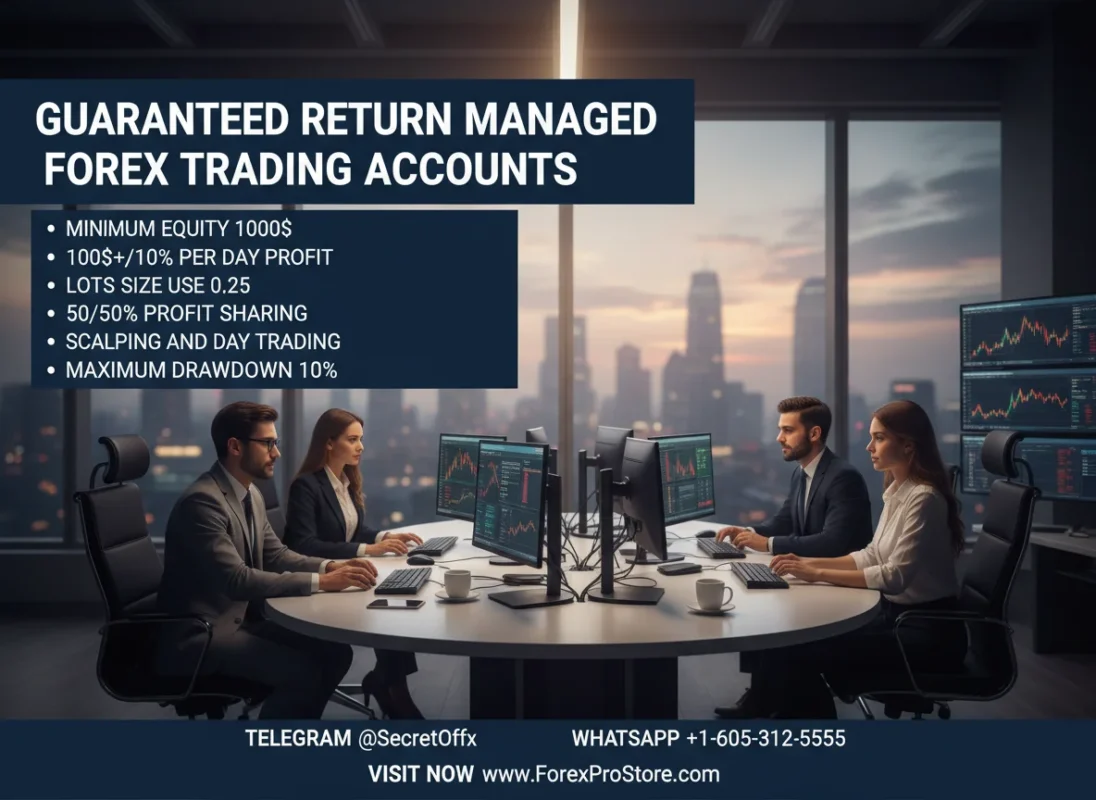
Guaranteed Return Managed Forex Trading Accounts
1. Introduction
Forex account management is often marketed with an intoxicating phrase: “guaranteed returns.” In a global financial landscape plagued by inflation and volatile equities, the allure of a hands-off, consistently profitable currency portfolio is undeniably magnetic. But beneath the glossy brochures and aggressive sales pitches lies a complex institutional reality. Forex account management is a legitimate service where professional money managers deploy capital on behalf of investors in the $7.5 trillion-a-day currency market. Investors flock to these services to bridge the gap between their own lack of technical trading expertise and their desire for alpha-generating alternative assets.
However, the retail space is saturated with misinformation. What you will learn in this article is the unvarnished truth about how managed forex trading accounts actually operate. We will strip away the marketing facade to explore the exact architectural setups used by true professionals, the brutal reality of market risks, and the mathematical impossibility of “guaranteed” yields. You will gain the analytical framework needed to differentiate high-status, regulated fund managers from retail-level illusions.
2. What is Forex Account Management?
At its core, forex account management is an investment vehicle where a third-party professional—the account manager—is granted trading authority over an investor’s capital. This is not a transfer of ownership; the capital remains in a segregated brokerage account under the investor’s name. The mechanism that makes this possible is a Limited Power of Attorney (LPOA).
The LPOA acts as a strictly defined legal firewall. It explicitly permits the manager to execute buy and sell orders, adjust leverage, and manage open exposure, but it categorically blocks them from depositing, withdrawing, or transferring funds. This structure ensures that the investor retains absolute custodial control of their liquidity.
The role of the account manager is purely analytical and operational. They monitor macroeconomic indicators, central bank policies, and technical price action, translating these variables into actionable trades. A legitimate manager acts as a fiduciary of your risk capital, prioritizing capital preservation over aggressive, reckless growth. They are compensated for their market edge, not for making impossible promises.
3. Types of Forex Account Management
The architecture of managed accounts varies depending on the scale of capital and the autonomy of the investor.
PAMM Accounts
PAMM (Percentage Allocation Management Module) is the industry standard for pooled retail funds. A manager trades a centralized master account, and the broker’s software proportionately mirrors these trades across dozens or hundreds of sub-accounts. If you hold 10% of the total pool’s capital, you absorb 10% of the lot size, 10% of the profits, and 10% of the losses. It is highly automated and seamless.
MAM Accounts
MAM (Multi-Account Manager) systems offer a more sophisticated, customizable approach. Unlike PAMM, where trades are strictly proportional, MAM allows the manager to adjust leverage, lot sizes, and risk profiles for individual sub-accounts. This is typically reserved for higher-net-worth investors who require a tailored risk approach within a broader trading strategy.
Copy Trading
Copy trading is the democratization of account management. Investors manually select a trader on a social trading platform and link their accounts to automatically replicate the trader’s positions. It is highly transparent and liquid, allowing investors to disconnect instantly. However, the barrier to entry for “signal providers” is perilously low, leading to highly erratic performance across platforms.
Individual Managed Accounts
This is the apex tier of forex management, tailored for VIPs, family offices, and institutional players. The manager trades a standalone account dedicated entirely to a single client. The strategy, risk tolerance, and drawdown limits are entirely bespoke. Because it requires intense, dedicated oversight, minimum investments usually start in the high six figures.
4. Benefits of Forex Managed Accounts
When executed through regulated, high-caliber professionals, the benefits of managed accounts extend far beyond mere convenience.
Time Saving
The foreign exchange market operates 24 hours a day, 5 days a week. It requires relentless monitoring of geopolitical events, algorithmic shifts, and global liquidity pools. Managed accounts allow investors to reclaim their time, outsourcing the psychological and temporal burden of active trading to those whose sole profession is staring at the charts.
Professional Trading
Institutional traders have access to resources retail traders do not: Bloomberg terminals, direct market access (DMA) liquidity, algorithmic modeling, and years of hardened market psychology. A managed account allows you to essentially rent this institutional edge, bridging the gap between amateur speculation and professional execution.
Risk Management
Amateur traders blow up their accounts due to emotional indiscipline and poor mathematical risk modeling. A professional manager employs strict quantitative risk controls, adhering to rigid risk-to-reward ratios and daily loss limits. They do not trade on “gut feeling”; they execute based on statistical probabilities.
Portfolio Diversification
Forex is an entirely distinct asset class. It has a remarkably low correlation to traditional equities and fixed-income markets. In a macroeconomic environment where stocks and bonds are experiencing simultaneous downturns, a well-managed forex portfolio can act as a powerful hedge, generating absolute returns regardless of broader market sentiment.
5. Risks of Forex Account Management
The concept of a “guaranteed return” in an environment dictated by global liquidity and floating exchange rates is a mathematical fiction. Understanding the risks is paramount.
Market Risk
Currencies are hyper-sensitive to surprise events—unexpected inflation prints, central bank interventions, or geopolitical flashpoints. “Black Swan” events can cause massive liquidity gaps and slippage, meaning even the most perfectly modeled trade can result in severe, unavoidable losses.
Manager Risk
Your capital is entirely at the mercy of the manager’s psychological stability and analytical competence. Even seasoned professionals endure “tilt”—periods of emotional trading following a string of losses. If a manager strays from their mandated strategy, the resulting damage to your portfolio can be catastrophic.
Drawdown Risk
Drawdown is the peak-to-trough decline of an account’s equity. It is the truest test of an investor’s stomach. A manager might average a 20% annual return, but if achieving that requires surviving a 40% drawdown along the way, many investors will panic and liquidate at the absolute bottom.
Scam Companies
This is where the “guaranteed return” myth thrives. Ponzi schemes, unregulated offshore bucket shops, and fraudulent signal providers use the promise of zero-risk, high-yield returns as bait. They fabricate trading statements and use new deposits to pay off older investors. If a company guarantees a return in forex, they are actively lying to you.
6. How to Choose a Forex Account Manager
Selecting a manager requires the clinical skepticism of an auditor.
Track Record
Do not look at a manager’s best month; look at their worst quarter. You need a verified track record spanning at least two to three years across various market conditions (bull, bear, and ranging markets). Longevity is the only true indicator of a sustainable statistical edge.
Verified Results
Screenshots of trading terminals are meaningless—they can be easily doctored. Demand third-party verification through analytical platforms like Myfxbook or FX Blue, and ensure the data is explicitly linked to a live, real-money account (not a demo account).
Risk Management Strategy
Before investing, you must interrogate their methodology. What is their maximum lot size per trade? What is their hard stop-loss threshold? What happens to the portfolio if there is a sudden 200-pip flash crash? If a manager cannot articulate a rigid, mathematical defense mechanism, walk away.
Regulations
Never deploy capital with a manager or broker operating out of a lax, offshore jurisdiction. Ensure the operation is overseen by Tier-1 regulatory bodies such as the FCA (UK), ASIC (Australia), or the NFA/CFTC (USA). Regulatory oversight ensures capital segregation and legal recourse in the event of malfeasance.
7. Forex Account Management Fees
Professional management is not cheap, but the fee structure should align the manager’s success with your own.
Performance Fee
This is the most common and equitable fee. The manager takes a cut of the newly generated profits—typically between 20% and 35%. Crucially, this should be governed by a “High-Water Mark” principle. If the account loses money, the manager earns no performance fee until the initial capital, plus all previous losses, is fully recovered.
Management Fee
Commonly seen in institutional or individual managed accounts, this is a fixed annual fee (e.g., 1% to 2% of total assets under management) charged regardless of performance. It covers the operational costs of running bespoke strategies. Avoid retail PAMM accounts that charge exorbitant fixed management fees.
Spread and Commission
While you pay the manager, you also pay the broker. Every trade incurs a spread (the difference between the bid and ask price) or a fixed commission per lot. Unethical managers sometimes collude with brokers to “churn” the account—opening and closing hundreds of trades not to make a profit, but to generate massive commission kickbacks.
8. Minimum Investment Requirements
The barriers to entry dictate the level of service and the architecture used.
$100
At this tier, you are strictly looking at retail copy trading. The risks are incredibly high, as you are likely following amateur signal providers. It is suitable only for testing platform mechanics, not for serious wealth generation.
$1,000
This is the typical baseline for entering a standard PAMM account. It allows retail investors to pool their capital alongside others. While accessible, the strategies at this level are often more aggressive to cater to investors looking to quickly double their small accounts.
$10,000+
At this level, doors open to more conservative, professional MAM accounts. Managers overseeing this tier of capital prioritize steady, risk-adjusted growth (1% to 3% per month) over aggressive gambling, as capital preservation becomes the primary mandate.
Institutional Accounts
Starting at $100,000 to $1,000,000+, these accounts offer bespoke LPOA agreements, individually tailored risk parameters, and direct access to Tier-1 prime brokerage liquidity. It is the standard for high-net-worth individuals requiring a highly professional, bespoke approach to wealth management.
9. Risk Management Strategies
How a manager defends capital is infinitely more important than how they acquire it.
Stop Loss
A hard stop-loss is a non-negotiable order placed to close a trade automatically at a specific price, capping the maximum possible loss. Managers trading without stop-losses are relying on hope, which is not a viable financial strategy.
Position Sizing
Professional managers do not risk large chunks of equity on a single idea. Position sizing dictates that a manager will typically risk no more than 0.5% to 2% of the total account equity on any individual trade, ensuring that a string of consecutive losses does not cripple the portfolio.
Diversification
A highly skilled manager will not simply trade EUR/USD. They will balance exposure across majors, crosses, and exotic pairs, ensuring that a sudden shock to the Eurozone or the US Dollar does not disproportionately impact the entire account.
Drawdown Control
Elite managers implement equity stops. If an account experiences a drawdown of, for example, 15% from its peak, the manager will systematically halt all trading. This pause allows them to recalibrate their algorithms and assess whether market conditions have fundamentally shifted away from their strategy.
10. Forex Account Management vs Copy Trading
While often conflated, these are fundamentally different approaches to passive trading.
| Feature | Forex Managed Accounts (PAMM/MAM) | Copy Trading |
| Control | Manager has full control over trade execution. | Investor manually selects and can intervene/close trades. |
| Professionalism | Usually run by vetted, licensed professionals. | Saturated with retail traders and amateur enthusiasts. |
| Customization | MAM allows for tailored risk settings per client. | Highly rigid; you blindly replicate the provider’s actions. |
| Fees | High-Water Mark performance fees; often highly regulated. | Platform markups, wider spreads, and subscription fees. |
Pros and Cons
Managed Accounts:
- Pros: Institutional-grade strategies, strict fiduciary duty, entirely hands-off.
- Cons: Higher minimum deposits, capital lock-up periods, stringent KYC/AML onboarding.
Copy Trading:
- Pros: Low barrier to entry, highly liquid, transparent real-time monitoring.
- Cons: High likelihood of following reckless traders, hidden platform fees, significant execution latency.
11. How to Start a Managed Forex Account
Entering the managed forex space requires methodical precision.
Broker Selection
The foundation of your investment is the broker. You must select an ECN (Electronic Communication Network) broker with Tier-1 regulation. Avoid market makers who trade against their clients. The broker must support seamless PAMM/MAM integration and offer deep liquidity.
Verification
You will undergo rigorous Know Your Customer (KYC) and Anti-Money Laundering (AML) protocols. This requires submitting government-issued identification and proof of residence. If a platform allows you to deposit large sums without verification, it is a massive red flag.
Funding
Fund the account using secure, traceable methods such as bank wire transfers. Avoid platforms that solely rely on obscure crypto transfers, as this significantly limits your ability to initiate a chargeback or track funds in the event of fraud.
Agreement Signing
You will sign the Limited Power of Attorney (LPOA). Read this document meticulously. It outlines the fee structure, the High-Water Mark clauses, the exact powers granted to the manager, and the process for revoking the agreement and withdrawing your capital.
Investors routinely sabotage themselves by falling into predictable psychological traps.
Unrealistic Profit Expectations
If you are expecting 50% returns every month, you are looking for a casino, not a financial market. Sustainable, professional forex management targets consistent, compounded returns of 10% to 30% annually. Chasing astronomical yields is the fastest route to total capital destruction.
Unverified Managers
Do not trust charismatic sales pitches on social media. If a manager claims to be a professional but cannot provide a third-party link detailing a multi-year, live-account track record, treat them as a fraud. Verification is the only currency of trust.
Ignoring Risks
Many investors only calculate what they stand to gain, completely ignoring what they stand to lose. Never invest capital that you require for daily living expenses. Forex is a high-risk alternative asset class; treat your managed account as a speculative growth vehicle, not a savings account.
13. FAQ Section
Is Forex Account Management legal?
Yes, it is entirely legal. However, it is heavily regulated. In reputable jurisdictions, account managers must hold specific financial licenses to trade on behalf of others, and the brokerage facilitating the LPOA must be registered with a recognized financial authority.
How much profit can I expect?
There are zero guarantees. A realistic, high-performing professional manager aims for 1% to 3% monthly returns. Anything consistently higher than this usually involves taking on an asymmetric amount of risk, which eventually leads to a catastrophic drawdown.
What is a PAMM account?
A PAMM (Percentage Allocation Management Module) account is a pooled investment structure. A professional trader executes trades on a master account, and the broker’s software automatically distributes the profits, losses, and trade sizes across all connected investor sub-accounts based on their percentage of the total pool.
Are managed accounts safe?
Your funds are secure from theft if held at a regulated broker under your own name with an LPOA. However, your capital is never safe from market risk. You can lose a significant portion, or all, of your investment due to poor trading decisions or unprecedented market volatility.

14. Conclusion
The search for “guaranteed return managed forex trading accounts” is a journey that often ends in disillusionment. The reality of the global currency markets is that risk is omnipresent, and absolute certainty is a myth propagated by scammers. However, when approached with a cold, analytical mindset, forex account management is a highly potent tool for portfolio diversification. By utilizing the expertise of verified, heavily regulated professionals through secure MAM or PAMM structures, investors can access institutional-grade trading strategies without dedicating their lives to staring at screens.
Your next step is rigorous due diligence. Stop looking for guarantees and start looking for verifiable, risk-adjusted track records. Select a Tier-1 regulated broker, demand absolute transparency from your prospective manager, and never deploy capital without a strictly defined risk management perimeter. The forex market rewards the educated and ruthlessly penalizes the naive. Protect your capital accordingly.
#ForexTrading #ManagedAccounts #GuaranteedReturns #ForexManagement #PassiveIncome #InvestmentStrategy #WealthManagement #FinancialGrowth #ForexSignals #CurrencyTrading #ProfessionalTrading #TradingAccounts #SecureInvesting #ForexExpert #AssetManagement