

Blog
Performance Fee for Forex Account Management

1. Introduction: The Mathematics of Delegated Trading
What is Forex Account Management?
Forex account management is a financial arrangement where an investor delegates the trading authority of their capital to a professional forex trader or a quantitative trading firm. Through a Limited Power of Attorney (LPOA), the manager can execute trades within the investor’s brokerage account but cannot deposit or withdraw funds. This structural separation ensures that the investor retains custody of their capital while outsourcing the execution of a trading strategy.
Why do investors use this service?
The foreign exchange market is the most liquid and heavily leveraged financial market in the world, operating 24 hours a day. Navigating it requires immense psychological fortitude, mathematical edge, and constant screen time. Investors use managed accounts to decouple their emotions from their capital, seeking to tap into “uncorrelated alpha”—returns that are independent of traditional stock and bond market movements. They are buying the manager’s time, algorithm, or psychological discipline.
What will you learn in the article?
Most articles treat managed forex accounts as simple passive income vehicles. This guide takes a different angle: examining the structural mechanics of how these accounts operate, the hidden mathematical realities of performance fees, and the game-theoretic risks of delegating leveraged capital. You will learn how to dissect a manager’s true edge, understand the intricacies of the High-Water Mark, and protect yourself from systemic vulnerabilities inherent in the industry.
Download Now Non-Repaint Indicator
Telegram Channel Visit Now
Fund Management Services Visit Now
2. What is Forex Account Management?
Definition
At its core, forex account management is an outsourced, performance-driven investment model. Unlike mutual funds where capital is pooled into a single corporate entity, managed forex accounts keep the investor’s money segregated at a regulated brokerage. The manager simply links their master trading terminal to the investor’s account, mirroring their trades proportionally.
How does it work?
The mechanics rely on specialized software provided by the broker. When the investor opens an account and deposits funds, they sign an agreement specifying the manager’s fee structure and risk parameters. The broker’s software then connects the manager’s “Master Account” to the investor’s “Slave Account.” When the manager buys 1 standard lot of EUR/USD on a $100,000 master account, the software instantly executes a proportional trade (e.g., 0.1 lots) on an investor’s $10,000 account.
Role of Account Manager
The account manager acts purely as the strategist and executor. Their mandate is to navigate market volatility, apply risk management protocols, and generate a positive yield curve. Crucially, their role is asymmetric: they provide the intellectual capital and reap a percentage of the profits, but they do not absorb the financial losses if the strategy fails. This structural reality dictates how performance fees are designed.
3. Types of Forex Account Management
Understanding how your capital is routed is just as important as the strategy itself. Different structures handle liquidity, slippage, and allocation differently.
PAMM Accounts (Percentage Allocation Management Module)
In a PAMM setup, the broker virtually pools the funds of all investors and the manager into one massive master account. Trades are executed as single, large block orders at the market. The profits, losses, and fees are then mathematically distributed back to individual investors based on their percentage share of the total pool.
- The Angle: PAMM accounts offer the best execution price because there is only one ticket sent to the liquidity provider, eliminating latency differences between investors.
MAM Accounts (Multi-Account Manager)
Unlike PAMM, a MAM account does not pool the money into one block order. Instead, it allows the manager to allocate trades based on different parameters—such as lot size, leverage, or equity—directly into individual segregated accounts.
- The Angle: MAMs are preferred by managers who want to tailor the risk profile for different clients (e.g., giving higher leverage to aggressive investors and lower leverage to conservative ones), but it can result in slight execution price discrepancies.
Copy Trading
Copy trading is a social trading framework where investors subscribe to a trader’s signals. The platform simply copies the trades from the provider to the follower.
- The Angle: This is the most retail-centric model and suffers heavily from “slippage.” Because the signal must travel from the provider to the platform, and then to your specific broker, you almost never get the same entry price as the manager, completely skewing the expected return.
Individual Managed Accounts
These are bespoke setups for high-net-worth individuals or institutional investors. The manager trades the specific account directly, often via API, tailoring the strategy to the exact liquidity constraints and risk tolerance of that single pool of capital.
4. Benefits of Forex Managed Accounts
Moving beyond the standard marketing of “making money while you sleep,” the true benefits of managed accounts lie in their structural utility for a broader portfolio.
- Time Saving & Emotional Decoupling: The primary cause of failure in retail trading is psychological degradation—revenge trading, over-leveraging, and fear. Managed accounts remove the investor’s hand from the mouse, enforcing discipline by proxy.
- Professional Trading & Infrastructure: Retail traders often lack the latency advantage, proprietary algorithms, and institutional data feeds that professional managers utilize. A managed account bridges this infrastructure gap.
- Risk Management: Legitimate managers utilize strict parameter-driven risk models, such as daily maximum drawdown limits and algorithmic position sizing, which retail traders rarely adhere to consistently.
- Portfolio Diversification: A well-managed forex strategy is often market-neutral. It does not rely on the S&P 500 going up or interest rates going down. It generates absolute returns based on currency fluctuations, serving as an excellent hedge against traditional equity market downturns.
5. Risks of Forex Account Management
This is where the industry’s structural flaws become apparent. The risks go far beyond simple market volatility.
- Market Risk: Forex is heavily leveraged. Unexpected macroeconomic events (like a sudden central bank interest rate hike or geopolitical conflict) can cause massive price gaps, blowing past stop-loss orders and causing severe equity damage.
- Manager Risk & The “Free Option”: Because managers take a cut of the profits but do not reimburse losses, they essentially hold a “free call option” on your money. This creates a moral hazard: some managers may take outsized risks to generate massive short-term returns (and collect high fees), knowing that if the account blows up, they simply lose their job, while you lose your capital.
- Drawdown Risk & The Death Spiral: If an account falls into a deep drawdown, mathematical recovery becomes exponentially harder. A 50% loss requires a 100% gain just to break even. A manager deep in a drawdown might abandon the PAMM to start a new one, leaving investors stranded.
- Scam Companies: The industry is rife with unregulated offshore brokers operating Ponzi-style structures or managers running “B-book” manipulation, where the broker trades against the client and splits the client’s losses with the manager.
6. How to Choose a Forex Account Manager
Due diligence requires looking past flashy marketing and dissecting the mathematical reality of a manager’s performance.
- Track Record (The Longevity Test): Ignore any track record shorter than 24 months. You need to see how the manager survived different market regimes (low volatility, high volatility, trending, and ranging markets).
- Verified Results: Only accept track records audited by third-party analytics sites like Myfxbook or FXBlue, and ensure the track record is on a Live Account, not a demo. Look for the “Track Record Verified” and “Trading Privileges Verified” badges.
- Risk Management Strategy (Sharpe & Sortino): Don’t just look at the total return; look at how much risk was taken to get there. Evaluate the maximum drawdown. A manager who made 100% with a 50% drawdown is vastly inferior to a manager who made 30% with a 5% drawdown.
- Regulations: Ensure the broker holding your funds is regulated by a tier-1 authority (e.g., FCA in the UK, ASIC in Australia, CFTC in the US). A great manager is useless if the broker refuses to process your withdrawal.
7. Forex Account Management Fees
This is the most critical element of the alignment between investor and manager. The fee structure dictates the manager’s behavior.
Performance Fee
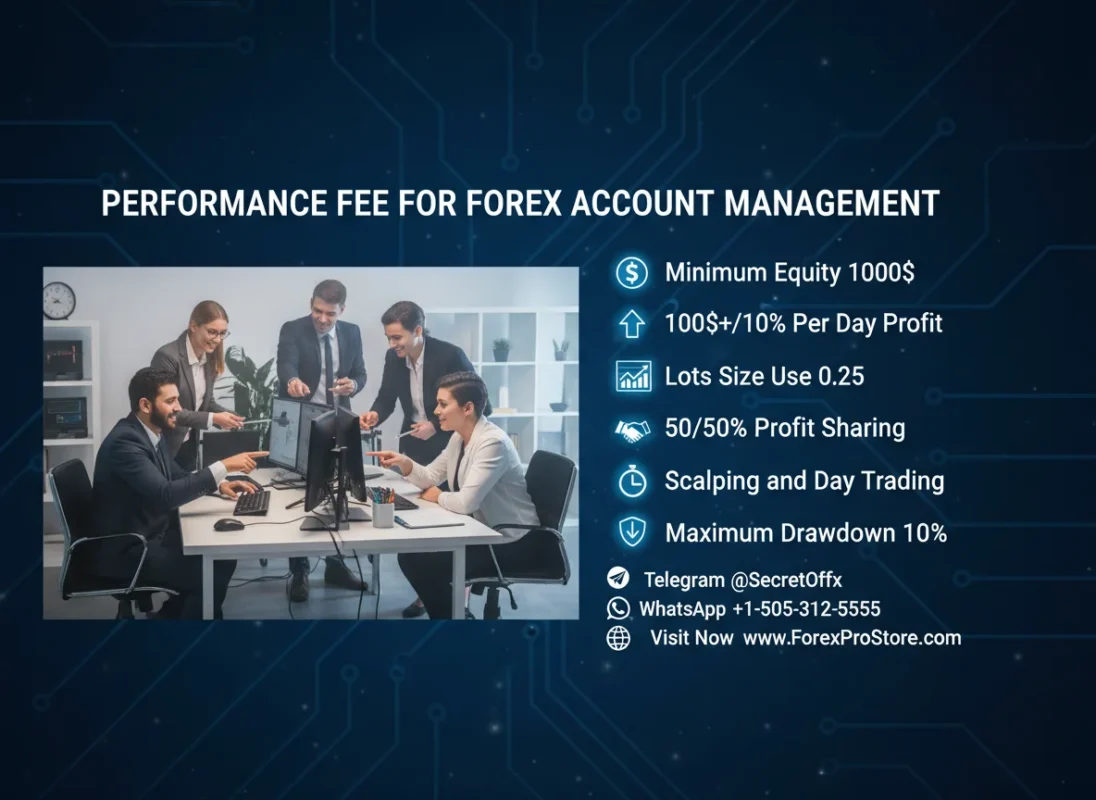
This is the standard compensation model, typically ranging from 20% to 35% of the new net profits generated. However, it is fundamentally tied to a concept called the High-Water Mark (HWM).
The HWM ensures you do not pay a performance fee for the manager simply recovering money they previously lost. If you invest $10,000 and the manager grows it to $12,000, they take their fee on the $2,000 profit. The new HWM is $12,000. If the account drops to $11,000 the next month, and then grows back to $11,800 the following month, the manager earns zero fees. They only get paid again when the equity surpasses the $12,000 HWM.
The Hidden Angle: Pay attention to how the HWM is calculated. Traditional NAV resets the HWM after fees are deducted, which is fair. Claw-Back NAV calculates the HWM before fees, which forces the manager to make up the gross high plus the fee they just took, often leading to them abandoning the fund if they hit a drawdown.
Management Fee
Some managers charge a fixed annual fee (e.g., 1% to 2% of Assets Under Management) to cover operational infrastructure, servers, and data feeds, regardless of performance. In retail forex, this is less common but highly prevalent in institutional settings.
Spread and Commission
Always check if the manager is receiving a rebate on the spreads or commissions from the broker. If a manager receives a portion of the trading commission, they are financially incentivized to “churn” your account—placing hundreds of unnecessary trades just to collect the hidden volume rebates, completely eroding your capital.
8. Minimum Investment Requirements
The barriers to entry vary drastically based on the structural execution of the strategy.
- $100 (Micro Accounts/Copy Trading): Usually reserved for highly unregulated, gamified copy-trading platforms. The risk of slippage and execution failure here is massive.
- $1,000 (Standard PAMMs): The entry point for decent retail PAMM accounts. However, at this size, lot allocation can be tricky. If the manager opens a tiny trade, the mathematical proportion for a $1,000 account might be less than the broker’s minimum lot size (0.01), meaning the trade won’t execute on your end.
- $10,000+ (Premium MAMs): The optimal starting point for serious retail investors. At this size, position sizing math works flawlessly, and it grants access to higher-tier managers who refuse to manage micro-capital.
- Institutional Accounts ($1M+): Bespoke individual accounts operating via FIX API, utilizing prime brokerage liquidity, offering the tightest spreads and lowest commissions.
9. Risk Management Strategies
A manager’s offensive strategy is secondary; their defensive protocols dictate your survival.
- Stop Loss: Every single trade must have a hard stop loss placed in the broker’s system. Strategies that rely on “mental stops” or grid/martingale systems (where losing positions are doubled down on) are mathematical time bombs.
- Position Sizing: The risk per trade should be static, typically between 0.5% to 2% of the total equity.
- Diversification: The manager should not be heavily correlated in their trades (e.g., going long on EUR/USD, GBP/USD, and AUD/USD simultaneously against the dollar constitutes one massive risk exposure, not three diversified trades).
- Drawdown Control (Equity Stops): The most crucial protection. The investor should have a platform-level equity stop. If the account loses 20% of its total value, the broker’s software should automatically detach the manager, close all open trades, and freeze the account, preventing further damage.
10. Forex Account Management vs Copy Trading
While often used interchangeably, these are vastly different execution models.
| Feature | True Managed Account (PAMM/MAM) | Copy Trading |
|---|---|---|
| Execution Environment | Server-side block allocation. | Client-side signal mirroring. |
| Slippage | Virtually zero. You get the manager’s exact price. | High. Delays cause you to enter at worse prices. |
| Control | Manager has full control over the pooled logic. | Follower can intervene, close trades early, or change multipliers (often ruining the strategy). |
| Fee Structure | High-Water Mark performance fees. | Monthly subscriptions or volume-based markups. |
| Ideal For | Passive, serious capital growth. | Retail users wanting to gamble on leaderboards. |
Pros and Cons: PAMM/MAM offers professional alignment and exact execution but requires higher capital and locking in your funds. Copy trading is cheap and flexible but mathematically flawed due to latency and execution discrepancies.
11. How to Start a Managed Forex Account
The onboarding process should be rigid, institutional, and secure.
- Broker Selection: Choose the regulated broker where the manager hosts their PAMM/MAM. Do not send money directly to a manager under any circumstances.
- Verification (KYC/AML): Provide your identification and proof of address to the broker to open your segregated account.
- Funding: Deposit funds into your newly created brokerage wallet via bank wire or approved methods.
- Agreement Signing (LPOA): Review and sign the Limited Power of Attorney digitally. This document restricts the manager from withdrawing funds and clearly outlines the performance fee and high-water mark stipulations. Once signed, you allocate your wallet funds to the specific PAMM strategy.
12. Common Mistakes to Avoid
- Unrealistic Profit Expectations: Retail investors often expect 10% to 20% a month. This is mathematically unsustainable without taking catastrophic risks. A top-tier manager aiming for 20% to 40% a year with low drawdowns is the reality of professional finance.
- Unverified Managers: Believing screenshots of MT4 profits on social media. Screenshots can be fabricated in seconds. Only trust live, third-party audited API links.
- Ignoring the High-Water Mark: Signing a contract that does not include a High-Water Mark means you could pay performance fees on money the manager is simply winning back after a loss.
- Falling for Martingale Traps: A strategy with a perfectly smooth, 45-degree upward equity curve with zero losing days is almost always a grid or martingale strategy hiding massive floating losses. They win small amounts daily until a black swan event wipes out the entire account in hours.
13. FAQ Section
Is Forex Account Management legal?
Yes, provided it is conducted through a regulated brokerage and the manager operates under a legally binding Limited Power of Attorney (LPOA). In certain jurisdictions (like the US), managers must hold specific licenses (e.g., CTA – Commodity Trading Advisor) to charge performance fees.
How much profit can I expect?
Institutional-grade managers target between 15% to 40% annually. Anyone promising guaranteed weekly or monthly fixed percentages is running a Ponzi scheme, as market volatility cannot be guaranteed.
What is a PAMM account?
A Percentage Allocation Management Module. It is a technical setup where a broker pools multiple investors’ funds into one master account traded by a manager, distributing profits and losses proportionally to each investor’s deposit size.
Are managed accounts safe?
The custody of your funds is safe if you use a tier-1 regulated broker, as the manager cannot steal your deposit. However, the trading risk is never fully safe; if the manager executes poor trades, your account balance will decrease.
Download Now Non-Repaint Indicator
Telegram Channel Visit Now
Fund Management Services Visit Now
14. Conclusion
Delegating your capital to a forex account manager is an exercise in transferring risk. By utilizing PAMM or MAM structures, investors can access professional algorithmic execution, emotional discipline, and uncorrelated returns. However, the industry is a minefield of misaligned incentives.
The key takeaway is to shift your focus from “how much can this manager make me” to “how does this manager protect my downside.” Understanding the mechanics of the High-Water Mark, demanding third-party verified track records, and recognizing the danger of the manager’s “free call option” are the true markers of a sophisticated investor.
If you are ready to diversify your portfolio away from traditional equities, begin by thoroughly auditing managers on analytical platforms, set strict equity stop-losses at the broker level, and treat managed forex as a calculated, long-term alternative investment rather than a get-rich-quick scheme.
#ForexTradingClientCare #ForexAccountManagement #PerformanceFees #ForexInvesting #ProfitSharing #TradingStrategy #FXManagement #WealthManagement #PassiveIncome #FinancialFreedom #AssetManagement #CurrencyTrading #ManagedForex #InvestmentPortfolio #ForexSuccess