

Blog
Certified forex account management services
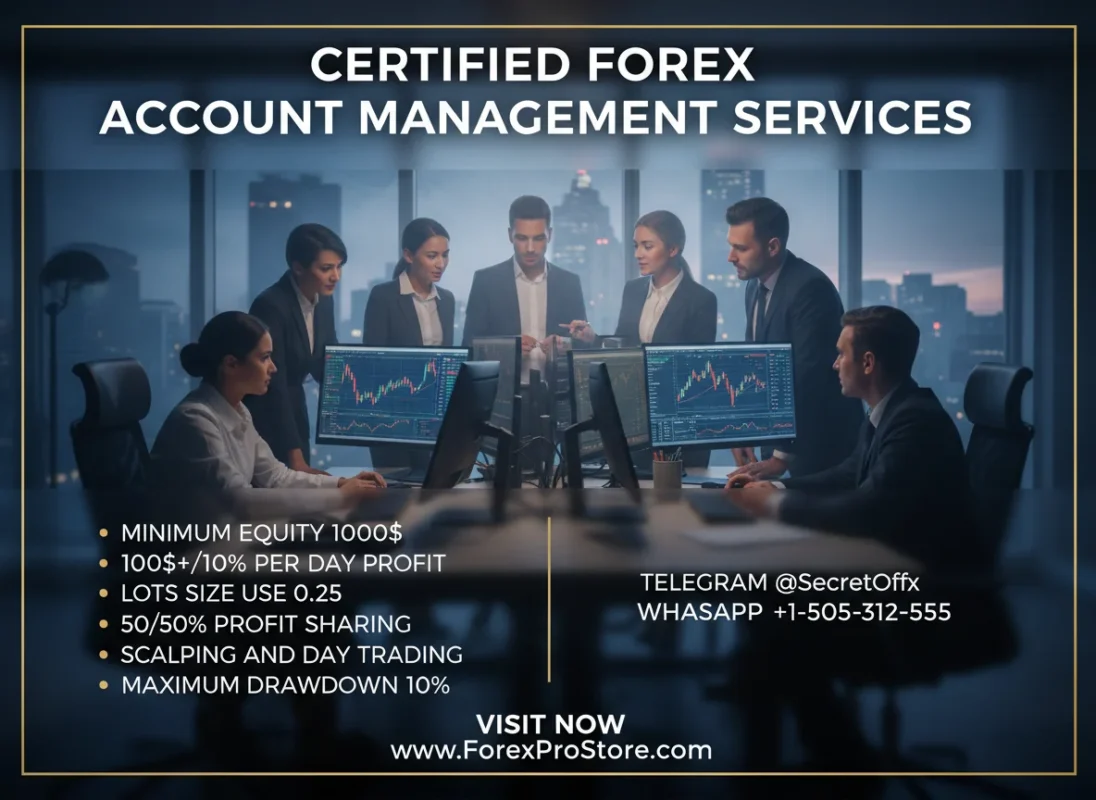
The foreign exchange (forex) market processes over $7 trillion in daily trading volume. For high-net-worth individuals, institutional investors, and ambitious retail traders, the appeal of extracting passive alpha from this massive liquidity pool is undeniable. This demand has given rise to a booming industry: “certified forex account management services.”
However, if you type that exact phrase into a search engine, you are usually met with generic marketing material from offshore brokerages pushing their PAMM (Percentage Allocation Management Module) platforms. The top articles on the internet rarely tell you the hard truth about this industry. They focus on how easy it is to make money, rather than how easy it is to be manipulated by hidden fee structures, unregulated “managers,” and conflict-of-interest broker partnerships.
This guide takes a fundamentally different angle. We are stripping away the marketing veneer to examine how professional, institutional-grade forex management actually works. You will learn why “certified” is the wrong word to look for, how to forensically audit a trader’s performance, and the exact step-by-step process for deploying capital safely into a managed currency portfolio.
Download Now Non-Repaint Indicator
Telegram Channel Visit Now
Fund Management Services Visit Now
The “Certified” Myth vs. Regulatory Reality
The first misconception to clear up is the word “certified.” In the forex management space, a “certification” from an online trading academy or a private broker means absolutely nothing. There is no globally recognized board that simply “certifies” a forex manager like a university issues a degree.
When you are looking for a legitimate money manager, the word you should be searching for is Regulated or Licensed.
True professional forex account managers operate under strict regulatory frameworks overseen by government financial watchdogs. For example:
- United States: Managers must be registered with the CFTC (Commodity Futures Trading Commission) and be a member of the NFA (National Futures Association) as a Commodity Trading Advisor (CTA). This requires passing the rigorous Series 3 and Series 34 examinations.
- United Kingdom: Managers must be authorized by the FCA (Financial Conduct Authority) to manage investments.
- Australia: They must hold an AFSL (Australian Financial Services Licence) issued by ASIC.
If a manager claims to offer “certified” services but cannot provide a regulatory license number from a Tier-1 jurisdiction, you are dealing with a retail trader, not an institutional manager. Entrusting capital to unlicensed entities dramatically increases the risk of fraud, reckless risk management, and the eventual loss of your principal.
The Architecture of Managed Forex: MAM, PAMM, and Institutional Accounts
Before deploying capital, it is critical to understand the technological infrastructure that connects your money to the manager’s trading decisions.
Retail PAMM (Percentage Allocation Management Module)
In a PAMM setup, investor funds are technically kept in their own accounts, but the capital is digitally pooled into a master account controlled by the manager. When the manager executes a 10-lot trade, the PAMM software proportionally distributes that trade across all investor accounts based on their capital size. It is rigid, treats all investors exactly the same, and is heavily favored by offshore retail brokers.
Retail MAM (Multi-Account Manager)
MAM is a step up in flexibility. While trades are still mirrored from a master account, the investor and manager can customize the risk profile. For instance, you could instruct the MAM software to only take 0.5x the leverage the manager uses, or cap your maximum allowable drawdown. MAM is better suited for investors who want to tailor their risk exposure.
Institutional Segregated Accounts (CTA / FIX API Model)
This is how true high-net-worth and institutional capital is managed. You open a segregated corporate or trust account at a prime brokerage or Tier-1 bank. You then sign a Limited Power of Attorney (LPOA) and grant the manager trade execution rights via a FIX API connection. The manager never pools your money with others; your account is traded individually based on a bespoke mandate.
Comparison: Retail Copy Trading vs. Institutional Managed Accounts
To illustrate the stark differences in the market, this table breaks down the typical retail offering versus a true professional service.
| Feature | Retail PAMM / Copy Trading | Institutional Managed Accounts (CTA) |
| Regulatory Status | Often unregulated or offshore-only. | Strictly regulated (NFA, FCA, ASIC). |
| Fund Custody | Retail brokerages (often B-Book market makers). | Tier-1 Prime Brokers or major clearing banks. |
| Capital Requirement | Very low (often $100 to $1,000). | High (typically $250,000 to $1,000,000+). |
| Customization | Zero to minimal; one-size-fits-all strategy. | High; bespoke risk mandates and hedging options. |
| Performance Fees | 30% to 50% of profits. | 15% to 25% of profits (usually with a HWM). |
| Hidden Conflicts | High risk of spread markups and rebate churning. | Transparent commission structures; audited execution. |
The Hidden Math: Evaluating Manager Performance Beyond ROI
The most common trap investors fall into is selecting a manager based solely on a high monthly Return on Investment (ROI). A manager generating 20% a month is almost certainly employing toxic risk management (like Martingale or infinite grid trading) that will eventually result in a total account blowout.
Professional capital allocators look at deeper quantitative metrics:
- The High-Water Mark (HWM): A legitimate manager will only charge performance fees on new profits. If your account starts at $100,000, drops to $90,000, and then recovers to $105,000, a manager using an HWM will only charge a fee on the $5,000 of actual net profit. Unregulated managers often try to charge fees on the $15,000 recovery, which is mathematically predatory.
- The Sortino Ratio: While the Sharpe ratio measures returns against total volatility, the Sortino ratio measures returns against downside volatility. A manager with a high Sortino ratio generates steady returns without subjecting your portfolio to terrifying, deep drawdowns.
- Maximum Consecutive Drawdown vs. Recovery Factor: How much of the portfolio did the manager lose at their worst point, and how long did it take to earn it back? If a manager has a 40% historical drawdown but only makes 2% a month, their recovery factor is terrible.
- Strategy Capacity (AUM Degradation): A strategy that generates 10% a month on a $10,000 account will often fail completely when scaled to a $10,000,000 account due to liquidity constraints and market slippage. You must verify that the manager’s strategy can handle the volume of capital they are accepting.
Step-by-Step Guide: How to Audit and Allocate Capital to a Forex Manager
If you are ready to explore managed forex services, you must act as your own auditor. Follow this professional onboarding sequence to protect your capital.
1.Conduct a Regulatory Background Check:Do not rely on provided certificates.
If they claim to be a US-based CTA, go to the NFA’s BASIC (Background Affiliation Status Information Center) portal and look up their name or firm. Ensure their registration is current and check for any historical disciplinary actions, fines, or customer complaints. If they claim FCA regulation, check the UK’s Financial Services Register.
2.Demand Third-Party Verified Track Records:
Screenshots of MT4/MT5 terminals are meaningless; they can be faked in seconds. Demand a live, third-party verified track record (such as Myfxbook or FX Blue) linked to a real money account, not a demo account. Furthermore, request “Read-Only” investor passwords to their trading terminal so you can independently verify their current open floating equity. A manager hiding massive unrealized losses will refuse this request.
3.Assess the Brokerage Environment:Avoid the B-Book trap.
This is the most critical step — who is actually holding your money? If a manager insists you must open an account with a specific, obscure offshore broker, walk away immediately. The broker could be a “B-Book” market maker taking the opposite side of your trades, creating an environment where corrupt managers are incentivized to blow up your account for a backend payout. You should always have the freedom to choose your own highly regulated, reputable broker (e.g., Interactive Brokers, IG) and connect the manager via API.
4.Structure the LPOA (Limited Power of Attorney):
When you are ready to proceed, you will sign an LPOA provided by your broker. This legal document explicitly restricts the manager’s capabilities. It allows them to open, modify, and close trades on your behalf. It must never grant them the ability to withdraw, transfer, or access your actual funds.
5.Deploy Capital in Tranches:
Never allocate your entire intended investment on day one. Start with the broker’s minimum requirement. Monitor the account for 30 to 90 days to verify that the trades executed on your account match the manager’s master account without severe slippage or latency issues. Only scale up your investment once the operational plumbing is proven to be sound.
Unmasking the Fee Structures: What Are You Actually Paying?
Understanding how your manager gets paid is vital to aligning their interests with yours. There are three primary ways forex account managers generate revenue:
- Performance Fees (The Standard): A percentage of the net new profits generated (typically 20% to 30%). This aligns their success with yours, provided a High-Water Mark is strictly enforced.
- Management Fees (Institutional): A flat annual fee based on total Assets Under Management (AUM), usually 1% to 2%. This is common in regulated CTA funds to cover infrastructure costs, but is rarely seen in retail MAM/PAMM accounts.
- The Hidden Trap — IB Rebates and Spread Markups: Some managers charge zero performance fees, which sounds fantastic until you realize they are registered as an Introducing Broker (IB) with the trading platform. The broker kicks back a portion of the spread or a commission to the manager for every lot traded. This creates a massive conflict of interest: the manager is incentivized to churn your account (overtrade aggressively) just to generate rebate revenue, entirely regardless of whether the trades are profitable. Always ask for a written declaration of any IB agreements the manager holds.

Download Now Non-Repaint Indicator
Telegram Channel Visit Now
Fund Management Services Visit Now
Conclusion: Is a Managed Forex Account Right for Your Portfolio?
True “certified” (regulated) forex account management services offer a legitimate pathway to diversify a portfolio into an uncorrelated asset class. A skilled currency manager can generate absolute returns regardless of whether global stock markets are in a bull or bear phase.
However, the retail forex space is heavily polluted with aggressive marketers, fabricated track records, and predatory fee structures. By shifting your focus away from hollow marketing buzzwords and towards regulatory licenses, quantitative risk metrics, and strict custodial control, you can filter out the illusions and locate genuine institutional alpha. Remember: in the world of managed forex, skepticism is your greatest asset, and verifiable data is the only currency that matters.